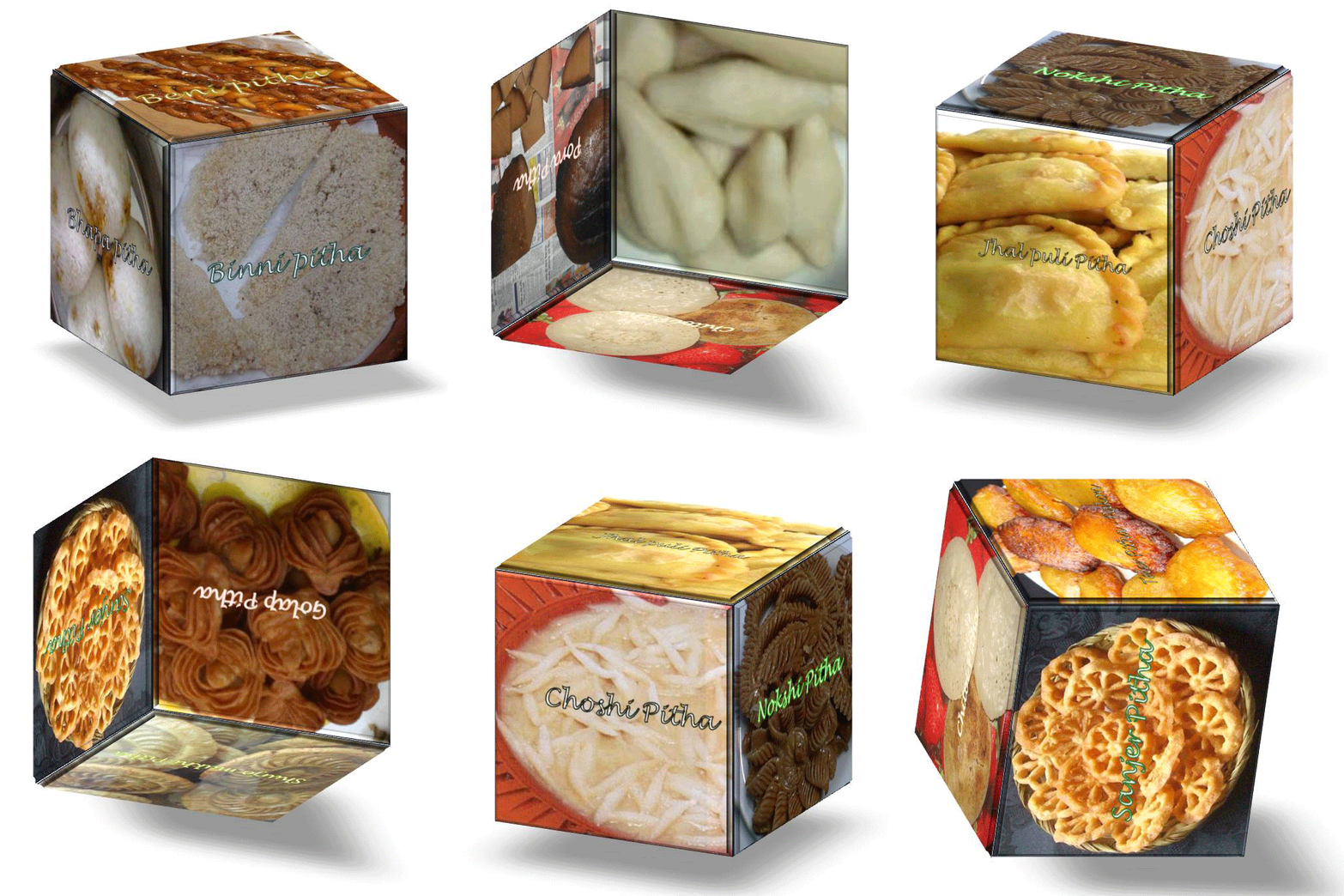
Praises of Bangladesh's pitha can be heard worldwide. The demand, pride, and elegance of this sweet delicacy, pitha or pithe, reaches its peak in the winter season. Rice from the newest grains and the beckoning smell of freshly prepared jaggery lure our tongue into a watery frenzy. The festival of pitha commences in West Bengal too during this time. Even though there can be no alternate to Bangladeshi pitha, West Bengal is not far behind, especially in rural areas. Widespread popularity of varieties of pitha can be noticed presently in this part of Bengal as well.
Not only on winter occasions, recently this delicacy has become a star preparation for many kinds of gatherings. Winter is considered the ideal season for making pitha since Nabanna aromatic Atap rice and the best quality jaggery come together to create the finest versions. In Bangladesh every winter is a spectacular season of occasions and competitions, from nationwide celebrations to household contests. Families exchange different kinds of pithas while the women of the household take part in competitive pitha making of many shapes, sizes, and types. One can truly imagine the celebration only by seeing it firsthand.
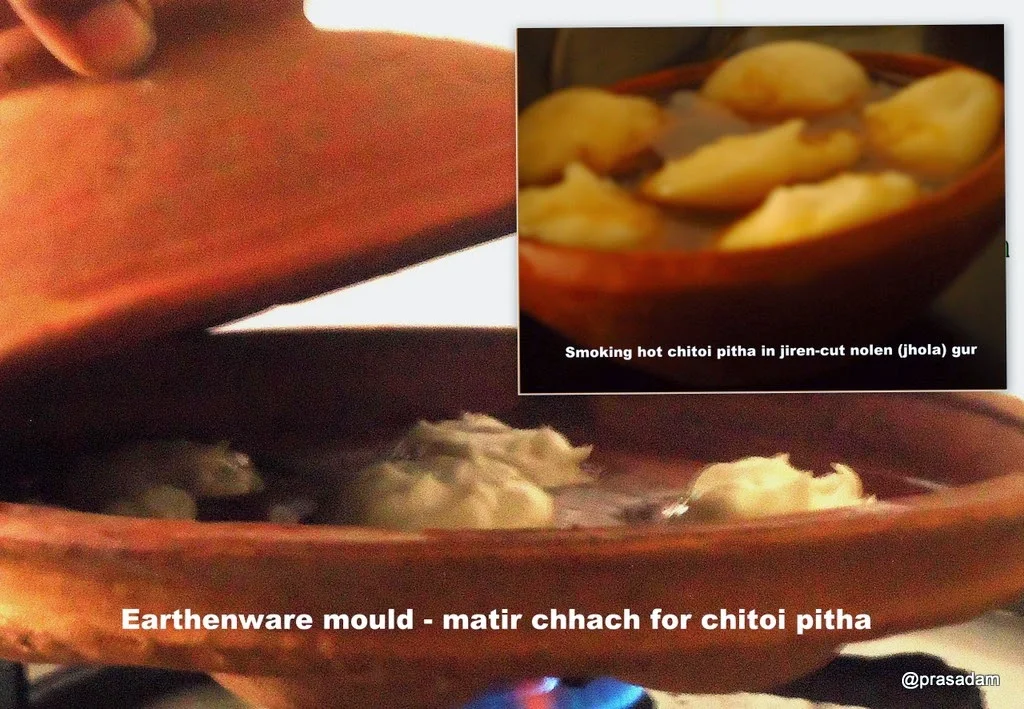
Sweet Chitoi Pitha dipped in Nalen Jaggery
It is generally known that sweetness is the ultimate parameter for assessing a pitha. A pitha may be dipped in date jaggery or sweetened in other ways. On the other hand, in the Bangladeshi pitha market various kinds of salted pithas are also found in striking proportion. Salty and spicy pithas demand appreciation alongside sweet pithas, though such a scene is less common in West Bengal. The kingdom of Bangladeshi pitha is inhabited not only by vegetarian subjects but also by non-vegetarian ones. Stuffing ingredients like egg, meat, and fish [fresh or dried] are widely accepted and appreciated. This is why Bangladeshi pithas are so varied and worthy of praise from the name itself, as one can often interpret the type of pitha and its primary stuffing from the name.
Prep time: 8 hours | Cook time: 15 minutes | Total time: 8 hours 25 min
Yield: Medium bowl | Serving size: 4 servings | Calories per serving: 175
Recipe Ingredients
- New Atap rice or short grain glutinous newly harvested rice powder: 1 cup
- Salt: 1/2 teaspoon
- Water to make thick batter: 1 and half cup
- Earthenware mould (matir chhach) or appam chatti
- Oil to grease the mould
- Baking powder: 1 and half teaspoon if rice soaking time is less than 6 hours
- Date liquid jaggery (jiren cut jhola gur): 1 cup
Recipe Directions
- Soak the rice flour overnight or at least 8 hours, mix with salt, beat well, and keep aside.
- Soak the earthenware mould in water for 2 to 3 hours, then keep it bottom side up.
- Grease the mould with cooking oil and heat over low fire. Pour the batter carefully into each depression, filling only two-thirds portion.
- Cover with the lid. Leave for 5 minutes over medium heat or until the edges solidify and turn opaque.
- Collect the pithas and soak them in slightly hot liquid jaggery (jhola gur) for 5 to 10 minutes before serving.
- In general, common pitha ingredients include new Atap rice (also boiled rice or Sheddho rice in some cases), date or palm jaggery, coconut, sugar, milk, coconut milk, sesame, oil, ghee, and flour. Other additions may include dry fruits, baking powder, cardamom, cinnamon, egg, punti shutki, chilli, salt, duck meat, and camphor.